Embroidery vs Printing Workwear: Which Should You Choose?
So you’ve decided your team needs branded workwear. Good call. Now comes the question that trips up more people than you’d think: should you go with embroidery or printing to get your logo onto the garments? Both look smart when they’re done right, both wear differently, and both suit certain jobs better than others. Here’s a straight-talking comparison to help you pick with confidence – no jargon, no pushy sales pitch, just what actually matters on the shop floor.
The quick answer
If you want to keep it simple: choose embroidery for polos, shirts, fleeces, softshells and anything that reads as a bit more premium or gets washed a lot. Choose printing for t-shirts, hi-vis, and larger multi-colour logos where you want detail, big coverage, or a lower unit cost on bigger runs. Plenty of businesses end up using both – embroidery on the smart stuff, print on the everyday stuff – and that’s a perfectly sensible way to do it.
How embroidery and printing actually differ
The two methods put your logo on a garment in completely different ways, and that difference is the root of everything else.
Embroidery
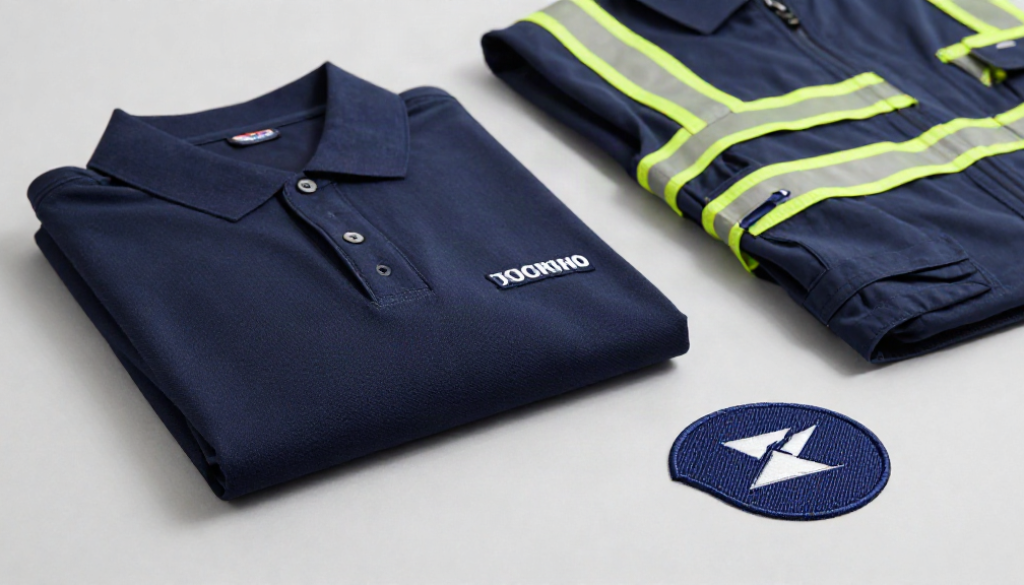
Embroidery stitches your design directly into the fabric using coloured threads. It creates a raised, textured finish that feels like part of the garment rather than something sitting on top of it. Because it’s stitched, it handles repeated washing and everyday wear without cracking or peeling. It’s the traditional choice for corporate workwear, uniforms and anything that needs to look sharp for years.
Printing
Printing applies your design to the surface of the fabric – usually a heat-applied transfer or a direct-to-film (DTF) print, which is the method most modern workwear suppliers use. It can reproduce fine detail, gradients, and lots of colours in one go, which embroidery struggles with. It’s fast, it’s flexible, and it’s often the more affordable option, especially on larger orders or for one-off events.
Look and feel: which reads more premium?
Embroidery wins on perceived quality. That slight three-dimensional texture catches the light and says ‘proper uniform’ in a way flat print doesn’t. If your team meets clients, works front-of-house, or you simply want the logo to feel like part of the garment, embroidery is usually the better-looking call.
Printing isn’t a downgrade, though – it’s just a different look. A well-applied DTF print is crisp, vibrant and modern. Where print really shines is detail: a small logo with fine lettering, a multi-colour design, or a photo-style graphic will reproduce far better as a print than as stitching. Some designs simply can’t be embroidered at small sizes without the letters blurring into each other.
Durability: which lasts longer on the job?
If the garment is going to be worn hard and washed constantly, embroidery is the tougher of the two. Stitched thread doesn’t crack, fade or peel the way a printed surface can over time. On heavy-use items like polos, fleeces and coveralls, embroidery will usually outlast a print – and keep looking tidy while it does.
Printing has improved enormously and a good quality DTF print will handle plenty of washes when it’s applied properly to the right fabric. But on garments that get hot-washed, tumble-dried or dragged through a tough working week, the print is the part that ages first. For hi-vis and short-life garments where the item itself gets replaced regularly, that trade-off matters less.
Matching the method to the garment
The fabric and the shape of the garment should guide your choice as much as anything else.
Roughly speaking: embroidery suits structured, mid-to-heavyweight garments – polos, shirts, sweatshirts, hoodies, fleeces, softshells, body warmers, coveralls and jackets. The fabric is stable enough to hold stitches neatly. Printing suits lighter and stretchier items – t-shirts, hi-vis vests and jackets, base layers – and it’s the go-to for large or detailed designs anywhere on a garment, including sleeves and backs.
There’s no rule that says a t-shirt can’t be embroidered or a fleece can’t be printed. It’s about what looks best and performs best for that specific garment.
Cost, setup, and turnaround compared
This is where the two methods diverge most, so here’s the honest version.
Embroidery costs more per logo because of the stitching time involved, and the price goes up with the size and stitch count of your design. Small left-chest logos are quick and affordable; big, complex embroidered designs take longer and cost more. The upside is that there’s usually no artwork setup cost – your logo just needs a stitch file, which most suppliers sort for you.
Printing tends to be cheaper per unit, particularly on larger runs, and it’s the more economical choice when you need big, colourful designs. The classic catch with printing has always been setup charges for screens or digital artwork preparation – but at Salutem Workwear there are no setup fees, so that barrier simply isn’t there.
On turnaround, both can be quick when the artwork is ready. Printing is often faster for one-off or small runs, while embroidery is fast once the stitch file exists because it doesn’t need screen preparation. Either way, the sooner you’ve got your logo sorted, the sooner your kit can be on its way.
Which should you choose? A simple rule of thumb
By now the decision usually comes down to a few questions:
Where will it be worn, and how often will it be washed? Hard-wearing and long-life – lean embroidery.
How detailed or colourful is the logo? Fine detail or lots of colours – lean printing.
What’s the budget and the order size? Big colourful runs on a budget – lean printing. Smart, premium, everyday uniforms – lean embroidery.
What’s the garment? Structured and heavy – embroidery. Light, stretchy or technical – printing.
Answer those four and you’ll have your answer most of the time.
Why you don’t have to pick just one
The smartest setup for a lot of businesses is a mix. Embroidered logos on the polos and fleeces the customer-facing team wears every day, printed logos on the t-shirts and hi-vis that get battered on site. You get the premium look where it counts and the flexibility and value where it matters.
If you’re weighing up embroidery vs printing workwear for your team, the honest answer is that the right choice depends on the job, the garment and the design – not on one method being better than the other. That’s why it helps to talk it through with people who supply both and aren’t trying to steer you toward one.
At Salutem Workwear, we do exactly that. No minimum order, no setup fees, both embroidery and printing under one roof, and a friendly chat to point you the right way. Send us your logo and what you’ve got in mind, and we’ll tell you honestly which method will look best and last longest on your kit.